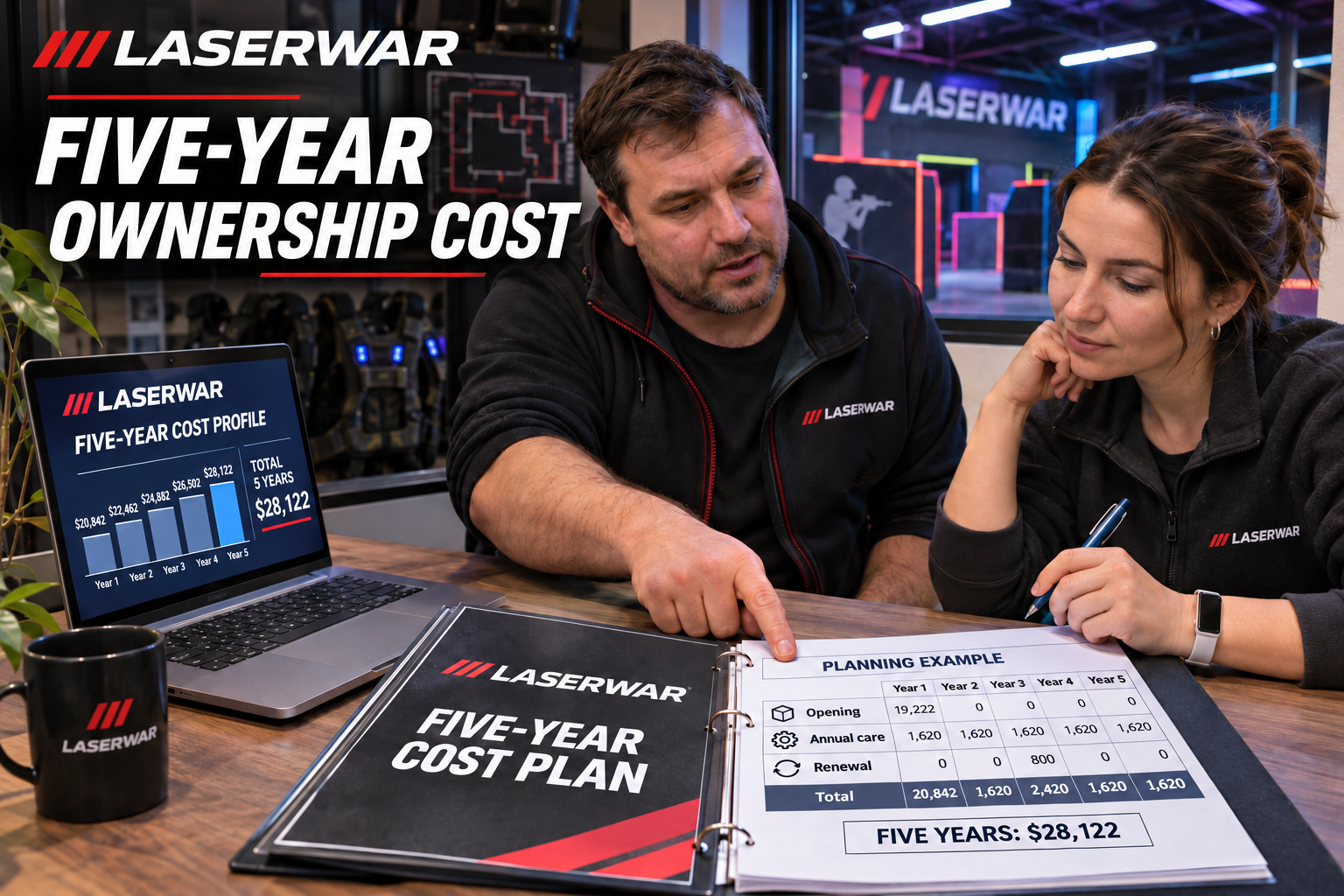
What does commercial laser tag equipment really cost over five years?
This is the illustrative total spent on buying, delivering, preparing and caring for the equipment fleet, after the assumed residual value. Club revenue and profit are outside this equipment-cost calculation.
The purchase price is the first line in an equipment budget. Five-year total cost of ownership adds delivery, installation, replacement parts, equipment care, software charges where applicable and planned renewals. Subtract a resale value only when you have a defensible estimate. Then divide the result by the capacity you actually intend to sell.
For a U.S. family entertainment center, this calculation is most useful before signing the equipment order. A lower invoice can lose its advantage if it leaves the operator short of complete player sets, charging capacity or a workable repair route. A more expensive feature earns its place when it solves a specific operating problem: quicker turnarounds, reliable scoring, easier instruction or a product guests want to book again.
This guide builds an equipment ownership model. Keep your full venue business plan alongside it for rent, game-host payroll, insurance, marketing, financing and fit-out. The two budgets answer different management questions; combine them once, with no repeated line items.
What can the club earn after its monthly costs?
Equipment ownership cost and business profit answer different questions. To see the earning side, use the companion U.S. laser tag revenue and profit guide. It combines public venue-price examples with an editable monthly operating model.
| Measure | Working example | Period and meaning |
|---|---|---|
| Sales revenue | $37,984 | One month of the example’s game and party sales |
| Profit before tax | $7,226 | One month, after stated operating costs, management, depreciation and interest |
| Profit after planning tax | $5,420 | One month, using an illustrative 25% tax allowance |
These figures are calculated from visible assumptions, not a U.S. average or an observed customer result. This separate model uses 20 active player places and needs its own fleet quotation; the ten-active-player packages in this ownership article do not automatically price it. The full profit guide shows the sales volume, wages, rent, other costs and break-even threshold behind the result.
Anchor the budget to a named configuration
On November 8, 2026, the linked LASERWAR configuration pages showed these USD package prices. They are catalogue reference points, before a destination-specific written quotation. Their accessories and playing formats differ, so the table is a starting point for scope, not a ranking of equivalent offers.
| Configuration | Listed equipment price | Player allocation for this comparison | Next budget question |
|---|---|---|---|
| StartUp v.9 Smart RGB Predator | $7,721 | 10 active + 2 complete reserves, subject to quoted bonus items | What else does the mobile or outdoor operation need? |
| The Best Choice v.10 X-GEN Wi-Fi | $9,349 | 10 active + 2 complete reserves, subject to quoted bonus items | What local network, computer and results display are required? |
| Alphatag Arena Start | $15,322 | 10 active + 2 complete reserves, subject to quoted bonus items | What arena, charging, control and installation scope remains? |
For the example below, we use the $15,322 Arena Start equipment price. We allocate twelve blaster-and-vest pairs as ten active sets and two reserves. That allocation is an operating choice. Selling twelve simultaneous places would consume those two reserves; it would not create a fourteen-set fleet. Confirm every main and bonus item, generation and charger in the final bill of materials. The equipment price guide explains the three packages in more detail.
Build the opening equipment budget in layers
Ask for delivery to your actual ZIP code. Separate the equipment price from freight, insurance in transit and any applicable destination charges. Request the delivery terms and the party responsible for each step in writing. A single “shipping included” line can still leave questions about the final delivery point, paperwork and unloading.
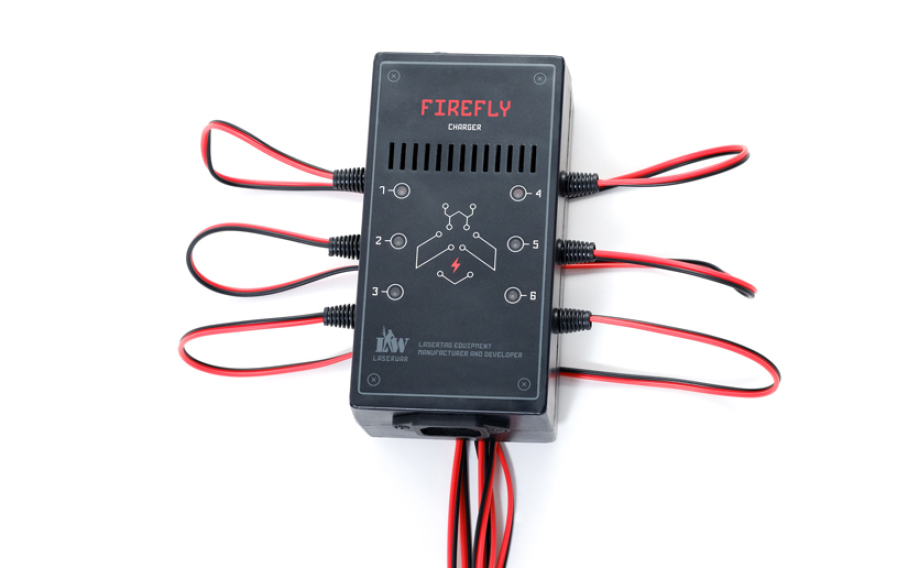
Next, walk the entire route from storage to guest handover. Where do sets charge? How many compatible ports are available at once? Where does an instructor check a sensor? What computer, router and screen does the quoted software setup use? Equipment that arrives before the control station is ready cannot support a fully rehearsed opening.
| Line | Example | Replace with |
|---|---|---|
| Equipment package | $15,322 | Final itemized equipment quote |
| Delivery and destination charges | $1,500 | Written charges for your destination; add applicable taxes where they are a business cost |
| Control station, installation and equipment training | $1,800 | Project-specific supplier and local costs, excluding anything already in the kit |
| Additional opening spares | $600 | Compatible spares beyond the included reserve sets |
| Opening equipment cash requirement | $19,222 | Excludes premises, attraction fit-out and working capital |
The $1,500, $1,800 and $600 amounts are editable planning assumptions. They are not LASERWAR quotes or U.S. market averages. Keep deposits and later payments on a separate cash calendar so the opening date does not conceal an earlier payment deadline.
Put recurring care into the operating routine
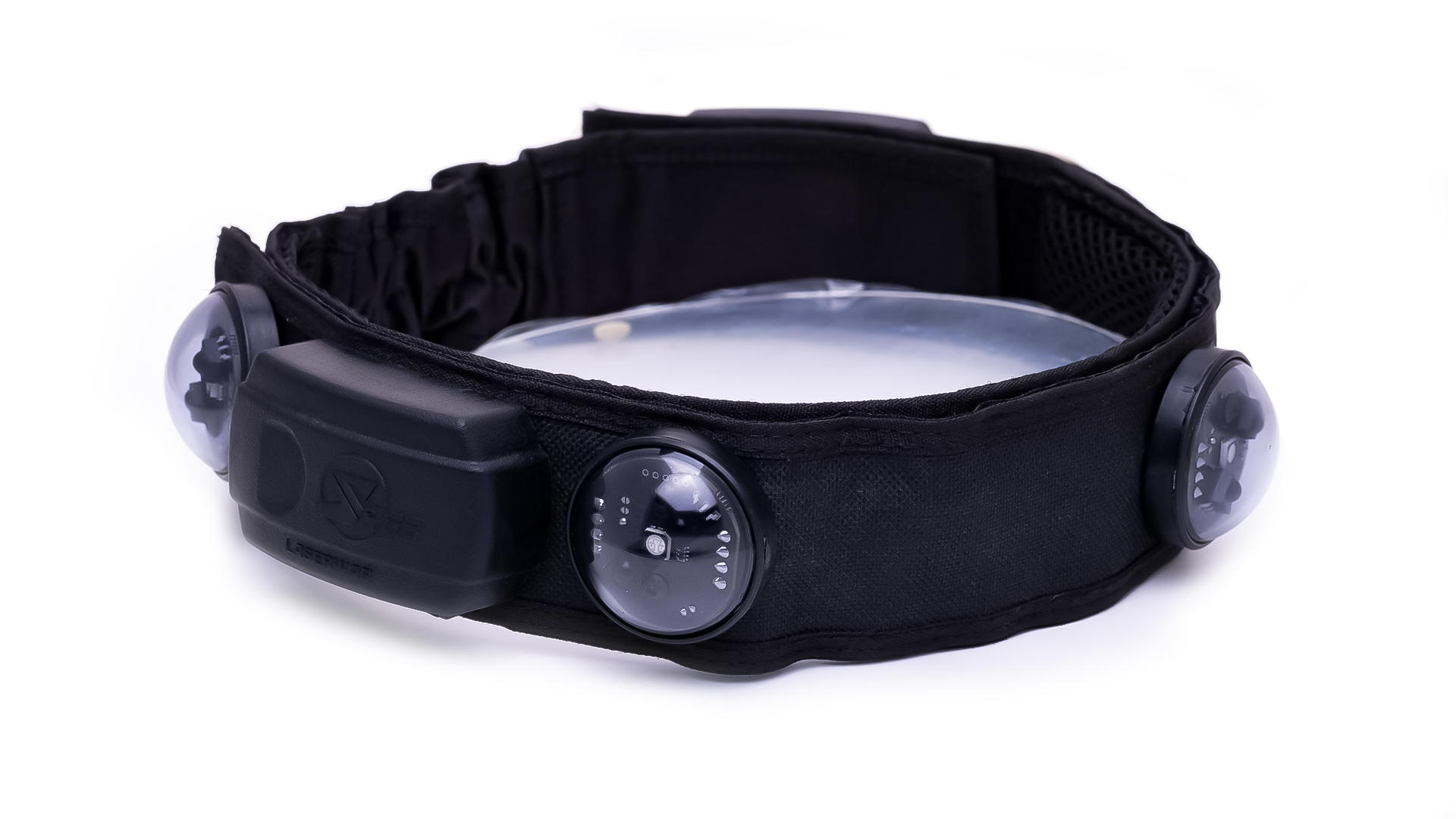
Build annual equipment care from tasks your staff will actually perform. Count inspection and cleaning time, hygiene components, compatible charging leads, replacement straps, paid repair work and the freight associated with it. Avoid charging the same hour to both general game-host payroll and equipment maintenance.
A small service log becomes more valuable than a broad “maintenance percentage.” For every intervention, record the asset ID, symptom, part used, staff minutes, outside invoice and return-to-play date. After a few months, you can replace assumptions with the club’s own experience and see which parts deserve a place on the shelf.
| Line | Calculation | Annual amount |
|---|---|---|
| Replacement parts and outside repair | Editable allowance | $600 |
| Equipment-care labor | 36 hours × $25 loaded hourly cost | $900 |
| Software or service fees | Enter the applicable contract | $0 assumed |
| Equipment electricity | Editable allowance; replace with measured consumption | $120 |
| Annual total | Same allowance in each of five years | $1,620 |
A zero software-fee input is a starting assumption, not a claim that every application, cloud feature, licence or future update is free. Ask which local software, accounts, updates, optional services and training are included in your exact offer. The software workflow guide separates local operation from internet-connected services.
Your five-year equipment worksheet
Change the inputs to match a quote and your operating plan. The default is an illustrative ten-active-player attraction. All values are nominal USD; the model holds annual costs constant and does not discount future cash flows. Use a separate cash-flow or financing model when the timing of payments matters.
See where five years of spending go
One player-play means one paid player taking part in one session. This is an equipment-cost allocation, not a ticket price, profit margin, return on investment or demand forecast. No data is submitted by this calculator.
| Component | USD / quantity |
|---|
The default arithmetic: $19,222 opening spend + (5 × $1,620 annual care) + $800 year-3 renewal − $0 residual = $28,122. Ten active places × twenty offered sessions × 65% paid occupancy × forty-eight weeks × five years = 31,200 paid player-plays. Allocated equipment cost is about $0.90 per player-play.
Utilization changes the answer even when the equipment stays the same
At the default ownership cost, filling more of the available places spreads equipment spending over more participation. That is arithmetic rather than evidence that a venue will reach the higher attendance. Choose occupancy from your bookings, capacity and opening schedule; a busy Saturday is a poor proxy for the whole week.
| Paid occupancy | Five-year player-plays | Equipment cost per player-play |
|---|---|---|
| 35% | 16,800 | $1.67 |
| 65% | 31,200 | $0.90 |
| 85% | 40,800 | $0.69 |
Session length also affects the capacity you can offer. Briefing, fitting, cleaning and collecting results take time between games. Use the FEC equipment guide to rehearse the turnover with your intended staff and guest age range before putting the final timetable into the business plan.
Price the repair route and the reserve together
A ready reserve gives an instructor a way to replace a faulty set during a session. Its value depends on the fault, available capacity and whether staff can complete the swap quickly. It does not guarantee that every booking will be protected or eliminate the need for repairs.
Keep cash repair costs separate from lost contribution. If unavailable equipment causes a booking to be declined, estimate the ticket revenue that would actually have been earned, then subtract the variable costs that booking would have required. Do not call the whole advertised ticket price a loss and do not count displaced guests again if they rebook.
Before buying, ask for compatible spare-part prices, the diagnostic contact, the repair destination and the return procedure for your U.S. order. Obtain service expectations in writing. The support and repair guide gives staff a practical diagnostic workflow and a ready-to-fill request template.
Plan renewals without guessing a battery lifetime
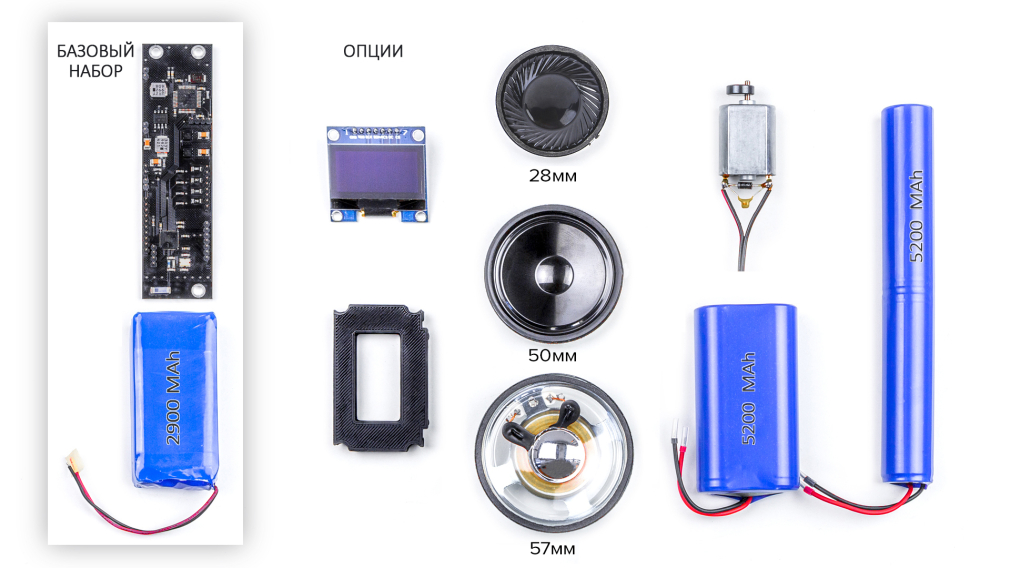
The calculator places an $800 renewal allowance in year three so the cash model includes a visible midlife intervention. It is not a predicted battery lifetime, a recommended replacement interval or a price for renewing this fleet. Replace it with the chosen device documentation, a parts quotation and the wear your operation records.
Review battery condition, enclosure damage, connectors, hygiene components and charger performance as separate assets. Record the staff time or service labor as well as the component price. Ask whether a part can be replaced locally, what instructions and skills are required, and when work needs to go through support. Follow the model-specific care and electrical instructions.
Carry a zero residual value while you have no sound resale evidence. A higher resale estimate makes the five-year number look lower, but it does not fund the original purchase or the next fleet. If you plan to trade in equipment, get the applicable assessment process and conditions rather than treating a possible future offer as cash already secured.
Make two suppliers answer the same five-year question
Send each supplier a common brief: active players, reserve policy, venue layout, operating hours, software and scoreboard needs, delivery ZIP code and opening date. Ask for both the bill of materials and recurring charges. Evaluate the proposed guest experience alongside the cost model.
| Compare | Evidence to keep with each quotation |
|---|---|
| Usable capacity | Complete active and reserve pairs; generation, sensor type and charging provision |
| Opening cash | Equipment, actual destination delivery, installation and required control hardware |
| Recurring charges | Local software, optional cloud features, updates, training and any contractual fees, with scope and dates |
| Care and repair | Compatible spare prices, practical repair route, labor responsibilities and freight terms |
| Performance in your setting | Reproducible acceptance test with the proposed generation, firmware and venue conditions |
The supplier comparison guide provides the shared request brief. Pair it with the field-test protocol so a feature is demonstrated before it becomes an operating assumption. Leave a competitor’s unknown fee blank until their offer answers it.
Turn the worksheet into a monthly decision tool
Keep the signed quote as the opening baseline. Once a month, update actual parts spending, maintenance time, paid participation and downtime. Compare the figures with your plan and explain material differences. A spare charger, a different fitting routine or better staff training can be a more focused response than replacing an entire fleet.
Update the forecast when the fleet changes, a service contract renews or the operating schedule expands. Keep old versions so a promising figure can be traced back to its price, capacity and occupancy assumptions. For the whole business, bring the equipment cash schedule into the laser tag business plan and add venue overhead and working capital.
Ask for a quote you can operate—and budget
Send your delivery ZIP code, guest age range, simultaneous player count, venue format and target opening date. Request an itemized fleet, charging and control plan, software scope and support route. Then replace the worksheet assumptions with the agreed numbers.
Discuss a LASERWAR configuration

