Laser Tag Business Plan: Startup Costs & Break-Even
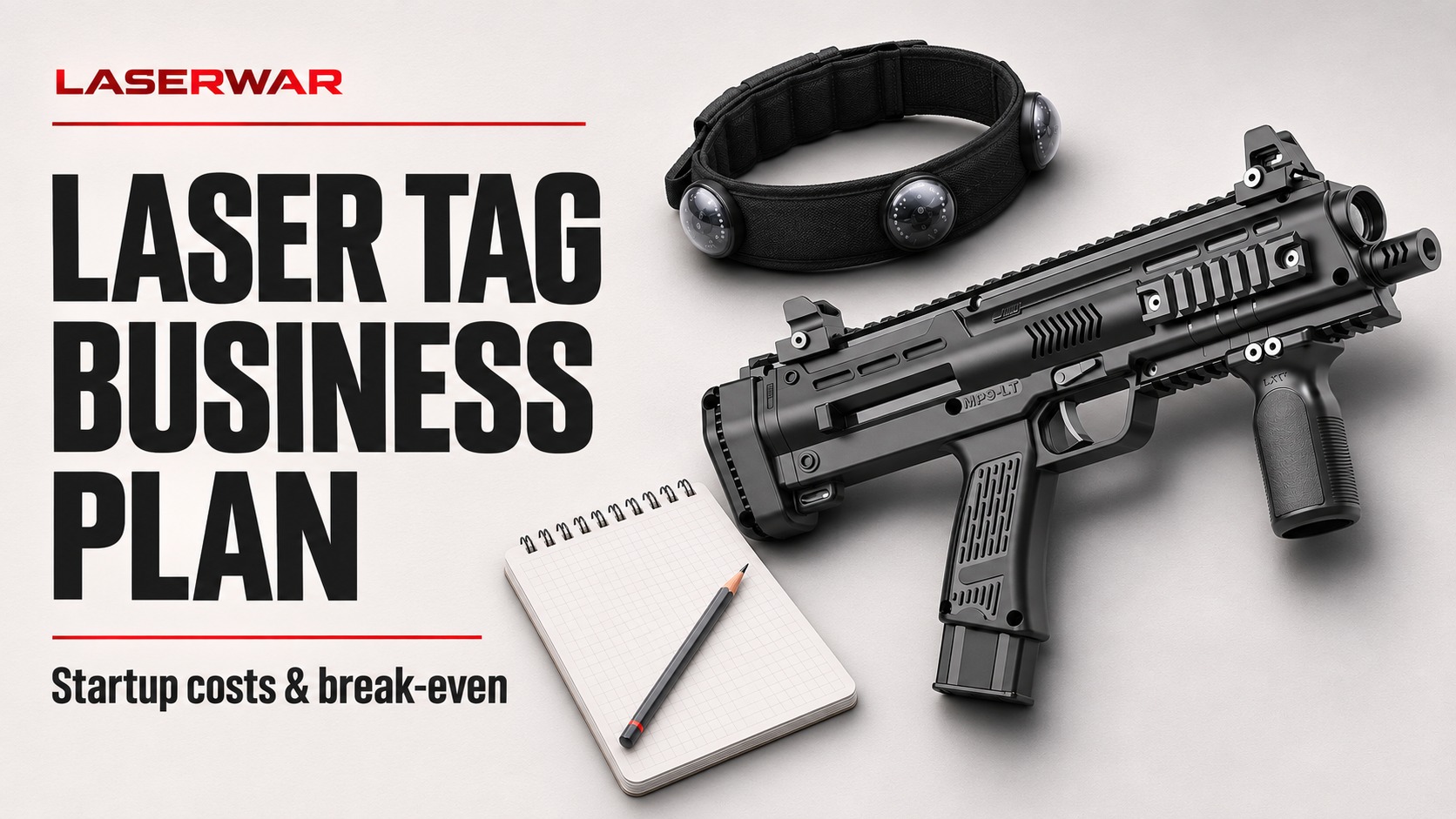
How much does it cost to start a laser tag business? On 3 November 2026, LASERWAR's StartUp v.9 Smart RGB Phoenix bundle was listed at US$7,281. Use that equipment price as a starting point, then add the costs of opening and running your own operation.
This guide separates published equipment prices from an illustrative operating budget. Delivery, applicable taxes, premises or transport, launch spending and working capital still need to be added. The operating example is a planning worksheet, not a record of customer earnings or a promise of returns.
Choose your business format
Choose the service format before estimating the total investment. A mobile operation, a fixed outdoor field and an indoor arena can use different premises, staffing and infrastructure.
On a small screen, scroll the table horizontally to see every column.
| Business format | Costs to investigate before opening | Recurring costs to investigate |
|---|---|---|
| Mobile laser tag | Complete equipment fleet, protective cases, transport access, portable field equipment, storage and booking setup. | Event labor, travel, site charges, storage, insurance, marketing and equipment care. |
| Fixed outdoor field | Equipment, site access, field layout and cover, reception, storage, charging and any required site work. | Site lease or access fees, staffing, maintenance, utilities, insurance and marketing. |
| Indoor arena | Equipment, premises, design and fit-out, reception, charging, storage and locally required building work. | Rent, staffing, utilities, maintenance, insurance and marketing. |
These are budgeting categories. Obtain local prices and requirements for your specific project rather than assuming a universal opening cost.
LASERWAR / STARTUP PLANNING
Inside the equipment budget


Choose an image or swipe horizontally. Select the photograph to enlarge it.
Build a verifiable equipment budget
The StartUp v.9 Smart RGB Phoenix bundle displayed the following items and USD prices when checked on 3 November 2026:
On a small screen, scroll the table horizontally to see every column.
| Listed equipment | Quantity | Displayed unit price | Calculated line total |
|---|---|---|---|
| MP9LT PHOENIX tagger | 10 | $494 | $4,940 |
| Smart RGB headband | 10 | $166 | $1,660 |
| Firefly Charger | 1 | $148 | $148 |
| Bluetooth Base | 1 | $19 | $19 |
| Spider Charger | 1 | $148 | $148 |
| Basic First Aid Kit game device | 2 | $140 | $280 |
| Smart Nano Remote | 1 | $86 | $86 |
| Published bundle total | $7,281 |
The page also lists two PHOENIX taggers and two Smart RGB headbands as gifts. These are additional to the 10 paid taggers and 10 paid headbands; their displayed values are not added to the total above. The “Basic First Aid Kit” is an electronic game device used for respawn, not a medical first-aid supply.
For the operating example below, allocate 10 complete sets to players and two to reserves. This is a planning choice, not a restriction on the bundle. Confirm the current specification and gift offer in your quotation.
The StartUp v.10 X-GEN Wi-Fi Phoenix bundle was listed at $7,948 on the same date: $667 more than the v.9 configuration. Its item list includes a router. The X-Gen Configurator requirements also call for a compatible Windows computer and Bluetooth capability for network setup. Check what you already own and what must be added to the order.
Use these as dated equipment references. Request the final price for your configuration and destination before committing funds.
Budget beyond the equipment
Keep an opening-cost worksheet with a supplier or local quote for each line. The separation between one-time and recurring expenses follows the budgeting approach described by the U.S. Small Business Administration.
| Budget line | Starting value or evidence needed |
|---|---|
| Selected equipment bundle | $7,281 for the verified v.9 PHOENIX example; reconfirm at order. |
| Freight and delivery | Quote for your address and shipment. |
| Applicable taxes and import charges | Confirm the tax treatment of the quote and destination charges. |
| Cases, storage and transport | Price the items and capacity you need; record existing assets separately. |
| Field or premises setup | Local quote for the selected business format. |
| Computer, networking and power | Check against the chosen generation and event workflow. |
| Launch costs | Your website, booking setup, initial promotion, training and locally required registrations. |
| Physical first-aid supplies and operating provisions | Provide separately from electronic game devices, according to your operating plan. |
| Working capital | A month-by-month cash forecast, including quieter periods and the timing of customer payments. |
LASERWAR's shipping policy says delivery options and rates depend on the shipment and destination. It also describes responsibility for import charges where they apply. Do not assume the displayed equipment amount is the complete delivered price; ask the quotation to state what is included.
Your opening funding requirement is:
Equipment + delivery and applicable charges + other opening costs + working capital.
Separate fixed costs from event costs
Monthly overhead continues even when you run fewer events. It may include storage, insurance, subscriptions, administrative time and a baseline marketing budget. Event costs rise with bookings: instructor time, transport, venue hire, payment fees and cleaning are examples to check.
Count the owner's time if the owner runs the games. Include loading, travel, setup, briefing, the event itself, cleaning and packing. If staff receive a fixed salary, put that salary in monthly overhead and avoid charging the same hours again as an event expense.
Maintenance also needs a budget. Keep routine care and replacement planning separate from any assumption that every issue will be covered by warranty. Check the applicable warranty terms when preparing your plan.
Worked example: a 10-player mobile service
Everything in this operating example is an illustrative assumption, not an observed LASERWAR customer result or a market-average price. All amounts are in USD. Replace them with your own customer pricing, local quotes and staffing plan. The example assumes an existing suitable vehicle; vehicle purchase and fixed vehicle ownership costs must be added if required.
Suppose you sell one booking for 10 players at $25 per player. Revenue per booking is 10 × $25 = $250. For simplicity, the model holds group size and selling price constant and treats customer prices as excluding taxes collected for authorities.
| Illustrative cost per booking | Assumed amount |
|---|---|
| Instructor or owner labor: 4 total hours at $20 | $80 |
| Travel allowance | $30 |
| Site fee | $25 |
| Cleaning and consumables | $10 |
| Payment fee allowance | $5 |
| Total variable cost per booking | $150 |
The assumed four labor hours cover the whole booking workflow. Check them against your travel distance and session format. A long journey or a second instructor changes the economics.
Each booking leaves $250 − $150 = $100 to cover monthly overhead and then contribute to the business. This $100 is the contribution per booking.
For illustration, assume monthly overhead and a maintenance reserve total $1,200: storage $200, insurance $150, marketing $300, booking software and communications $100, a maintenance reserve $150, and administrative labor $300. These are demonstration inputs, not supplier quotes. Review them against the services and coverage you actually need.
Calculate your monthly break-even
Use the SBA's break-even formula: fixed costs divided by the selling price minus variable costs per unit. Here, one unit is one completed booking. Because this worksheet includes a maintenance reserve, its target covers the planned monthly budget, including that reserve.
Bookings to cover the budget = $1,200 ÷ ($250 − $150) = 12 per month.
If a calculation produces a fraction, round up to the next whole booking. If contribution is zero or negative, increasing bookings alone will not cover monthly overhead under those assumptions.
On a small screen, scroll the table horizontally to see every column.
| Monthly scenario — illustrative | Low: 8 bookings | Base: 16 bookings | Busy: 24 bookings |
|---|---|---|---|
| Revenue | $2,000 | $4,000 | $6,000 |
| Variable costs | $1,200 | $2,400 | $3,600 |
| Contribution | $800 | $1,600 | $2,400 |
| Overhead and maintenance reserve | $1,200 | $1,200 | $1,200 |
| Planning surplus / shortfall | −$400 | $400 | $1,200 |
These results exclude tax, financing, depreciation and recovery of the initial investment. The maintenance reserve is a planning allocation; the table is not a statutory profit-and-loss statement. Staffing and overhead are held constant for comparison, so check whether the busy scenario needs extra capacity or supervision.
Four lost bookings reduce the base scenario from 16 to 12 and remove its $400 surplus. Use completed, paid bookings in the forecast, and consider seasonal demand and cancellations when choosing your working-capital reserve.
Separate break-even from investment payback
Covering the monthly budget does not recover the money spent before opening. Payback requires enough cash remaining after operating costs and other obligations to recover the full initial investment over time. Estimate it using a month-by-month cash forecast, with startup spending, seasonal bookings, taxes, financing and replacement purchases included.
For example, three months of the illustrative $1,200 monthly budget equals $3,600. Adding that reserve to the verified $7,281 equipment price gives a $10,881 partial funding subtotal. Delivery, applicable charges, other opening costs and any additional cash needed for event expenses must still be added. Three months is an example reserve period; choose your own using the cash forecast.
Request an itemized quotation
Start with your city and country, business format, simultaneous player count and reserve allocation. Add the sessions you expect to sell, equipment you already own and whether you need live statistics. Ask suppliers for itemized configurations and obtain local quotes for the remaining budget lines.
Explore LASERWAR laser tag business options, compare complete equipment bundles, or request a configuration and delivery quote. A useful business plan connects that quote to a realistic booking schedule and the actual cost of delivering each event.
Product photographs: LASERWAR. Cover: editorial illustration based on manufacturer product imagery. Figures refer to the configurations and sources stated in the article.


